

Communicating effectively
Published: October 15, 2007
SUMIT BHATTACHARJEE
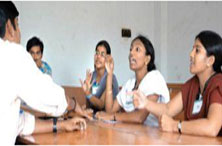 Effective communication skills help understand the opposition’s mental map and match their perception
Communication is an important facet of life. Communication skills are essential in all spheres of existence.
The success of any endeavour hinges on the ability to communicate effectively.
In today’s fast-paced life, everyone is asked to do more with less. In such a scenario effective communication holds the key.
Over the years experts have been harping on communication skills but there is a vast difference between mere communication and effective communication.
What is required today is to understand and assess how effective is our communication and at the same time make the opposition respond to our communication.
“In simple terminology, effective communication skills would be to understand the opposition’s mental map and channelise our communication to match others’ mental perceptions,” says A.S. Prasad of CTC Communication.
Elucidating the concept with a true happening he says, “A fresh engineering graduate was once asked in her first interview:
What are your strengths and weaknesses? After revealing her strengths, she turned the table back to the interviewer and said:
Why should I tell my weakness - you might rather turn it on me later.
Though her reply may be termed brash, she was selected, while her friend, who despite her better academic record, could not get through.
What finally matters is how effectively one can communicate.”
It is a known fact that most of the people who attend interviews mug-up the FAQs (frequently asked questions) before an interview session but
finally only a couple get through. The edge the selected ones enjoy over the rest is nothing but effective communication skills.
Mental mapping
Be it an interview or dealing with the project leader or working out a solution with a team, mapping of the mental perception of the opposition plays the key role in effective communication.
Mr. Prasad says that the thought process of human beings can be broadly segregated into three areas: words, visual and feelings.
The three classifications are important to assess the mental perception of the opposite side.
Effective communication centres round the usage of words, speed of delivery of words, pitch modulation and body language.
The usage of words is very important.
In the present concept of global village, language has become essential part of work culture.
The usage of a single word can either spell doom or enhance the chances. Relationship is built on words.
Listening skills
“Listening skills also play a key role in the usage of words. Listen to the opposite side with full concentration and reply using the appropriate words at the appropriate time.
Make the conversation sound simple and be crisp. Avoid using a few words like can’t, because, but, should and could. These words transmit negative vibes,” he says.